
Prof Alex Haslam, Professor of Social and Organisational Psychology, University of Queensland
Prof Maureen Hassall
MISCH SMI The University of Queensland

Prof Maureen Hassall
The University of Queensland
Ian Hawkins
Seam Gas Manager, Anglo American – Moranbah North Mine
Minimising risk to our people is Anglo American’s number one priority. Anglo American has implemented a system to improve the control of works being conducted on the surface to support the underground operations.
Recognising that unplanned work can often be the most unsafe, Moranbah North operation has taken advantage of the existing, proven underground planning tool and processes (Fewzion) and aligned the surface operations to these processes.
The surface area of the mining lease has been split into geographical zones with a zone controller responsible for each zone.
All activities in each zone are planned within a shared database (Fewzion) and managed and scheduled through planning meetings and agreed processes.
Any break-in or unplanned work is assessed independently by the activity owner and zone controller prior to approval to proceed is granted.
Zoning of surface works provides confidence that:
- All surface work activities are planned and scheduled, minimising the need for break-in and unplanned work
- Permits to Work are in place, with associated risk assessment and hazard identification completed
- Simultaneous works are identified – minimising conflicting work areas
- All work is communicated to all surface workers – maximising awareness
- Break-in work is effectively managed, as it is planned through the scheduling process.
Bill Haylock
Director, Green Ticket
All mine sites have two things in common—workers and risks. Their workforce, the company’s biggest asset, need to be trained efficiently and effectively on hazards’, risks’ and incidents’ management. Mine site workers handle highstakes machinery and dangerous substances in high-risk settings. The success of risk procedures for a company depends on how well workers understand, accept, and implement these procedures. Without appropriate knowledge and specific tools workers are at high risk of impacting their safety and health, while also undoing corporate compliance measures implemented by management. To mitigate this, we need cost-effective and time-efficient tools. We need targeted, pertinent, specialised training.
This raises questions about what tools contractors need to do the job and how these tools can effectively and efficiently be created and delivered.
Questions to address:
- What is the decision-making process undertaken to create a targeted, pertinent, specialised training program?
- What is the problem?
- Who is at risk?
- What are the regulations?
- Who is the target?
- What are the methods of delivery and desirable frequency?
- What locations?
- What are the workers’ levels of literacy?
- And most importantly, what decision-making processes help to answer these questions and get cut-through to the workers?
Steve Hedges – SVP Operations
David Champion – Safety Manager, Millennium Mine, Peabody
ABSTRACT
In early 2016, with Millennium Mine nearing the end of its planned mine life, the site took on a new challenge – to use auger mining to maximise resource recovery by endeavouring to win coal from two final highwall positions. The team set about engaging a specialist auger mining contractor who had worked in Queensland for a number of years. The contractor had a system of work in place based on experience gained in both the United States (US) and Australia.
However, the previous research relating to the effectiveness of the controls was conducted in the US in the early 1990’s. The absence of a real time gas monitoring system on the auger led the Queensland Coal Mines Inspectorate to issue a (S169) directive to suspend augur operations at Millennium pending resolution of a range of concerns relating to the risk assessment, standard operating procedure (SOP) and work instructions.
The directive was extremely broad and difficult to achieve.
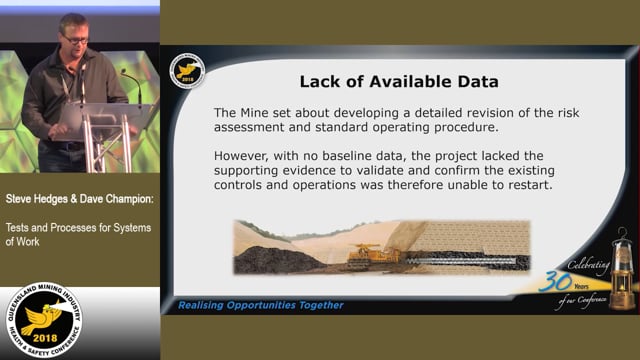
Over the next six weeks the Mine set about developing a detailed revision of the risk assessment and SOP. However, with no baseline data, the project lacked the defined processes to verify and confirm the existing controls. The Operation was therefore unable to restart.
In May 2016 the Mine sought a review of the directive by the Chief Inspector. Ultimately this led to a revised directive (S166).
The use of this revised regulatory approach allowed for:
• Verification of the risk assessment controls;
• Development of a series of new systems of work to be tested;
• New controls to be proven through a framework of research and development of the mining system.
A series of test and verification programmes was developed using risk assessment techniques that involved technical experts from various specialist fields.
This then allowed the project to develop in stages and to progressively deliver an ‘acceptable’ level of risk based on proven methods of control.
At each stage a plan was developed, submitted and reviewed with the regulator with a subsequent update of the section 166 directive. The results were then further reviewed with the regulator as part of defining the next steps. Success was achieved by the regulator, Mine operator and the contractor working closely to develop a series of best practice controls using the latest available technology, underpinned by fundamental risk management practises.
In March 2018 the final directive was closed.
Wayne Gregory Herbertson
Russell Mineral Equipment
Genevieve Hey
Director/Principal Consultant, Genevieve Hey Consulting Pty Ltd
A mines’ safety and health management system must provide protocols for physical and psychological impairment; but what does this mean? A protocol, like a standard operating procedure, governs behaviour and the performance of tasks; therefore, it should be underpinned by a sound risk management process that identifies and controls hazards within the given context. Unfortunately, studies show that industry more readily applies risk management processes to physical rather than psychological hazards; nevertheless, both must be considered for health and safety obligations to be fully discharged.
To complicate matters further, the analysis of psychological risk differs from that of physical risk due to its complexity.
Psychological risk factors are multi-causal, not directly observable and their severity is largely determined by individual perception. With this in mind, how is psychological risk quantified without bias and in a way that facilitates its systematic analysis? Additionally, how are protocols that reflect a mines’ unique psychosocial risk profile developed?
This paper provides the answer by discussing two workplace psychosocial risk assessment tools that are freely available online and grounded in evidence-based psychological research. Furthermore, these tools can be easily applied at your mine by your own Human Resource or Health and Safety specialists.