Michael Tamone
State Sales Manager – Queensland, uvex safety Australia
uvex is established as a world leading manufacturer of sports and safety PPE with more than 90 years’ manufacturing experience.
The uvex mission is protecting people, with our three core values being quality, leadership and enthusiasm. Our focus is on science-based innovation to create Personal Protective Equipment including safety eyewear, hand, respiratory and hearing protection for people at work.
Over the past year uvex Safety Australia has officially launched our global partnership with Grand Rapids Michigan based protective product manufacturer, HexArmor. HexArmor are the global leaders in extreme cut, impact, puncture and needlestick resistance hand and body PPE. Our dedicated team welcome your visit to our stand #19 at the conference.
Eric Tomicek
Sales Manager, Australian Diversified Engineering
ADE is passionate about haul roads and efficient water truck operations. The ADE Spray system consistently sprays at a specific water rate to manage overwatering and underwatering and can safely deliver more water to more of the mine. Friction Plus by ADE is a free phone app for measuring haul road friction so that risks associated with wet roads can be objectively measured and the risks effectively managed.
Dr Ross Tynan
Research Lead, Everymind
Supporting a healthy workforce has a range of potential benefits: improved employee performance and morale, improved safety, cost benefits, and broader social benefits to employees, their families and community. Achieving such gains requires timely and early access to effective options for providing health in a form that is tailored to the target population and the Industry more broadly. While health screening has been introduced in some sectors of the Coal Industry, innovative, accessible treatment options that wrap around available workplace health care options are needed.
This paper reports on the development and evaluation of a proposed solution; an online portal (‘Health-e Mines’) that provides a direct, real-time link between coal mining employees and the latest evidence based online screening, early intervention, and treatment programs for enhancing mental and physical health. Since January 2018, there have been 817 Health-e Mines site users. This has translated into 1,485 sessions by coal miners visiting the website, who have viewed, on average, two pages per session. The majority of visitors are accessing the site on Sundays at 4am, Mondays 12-3pm, and Wednesday 6-11am. Evaluation data on facilitators and barriers to use of Health-e Mines will also be reported.
Dr. Philip Tynan
National Toxicologist, Safe Work Laboratories
It is widely accepted Customs and Police Drug confiscation, self-report surveys (such as the National Household Drug Survey), and roadside and workplace drug testing give only a crude picture of overall community drug use. By assaying drug concentrations in sewage effluent, it is possible to obtain timely information on the actual spectrum of drugs used at a site and calculate the average drug dose per person.
Wastewater Drug Testing has been used internationally and in Australia (in the National Wastewater Drug Monitoring Program 2016 – 2019) to measure and interpret drug use within national populations and at selected worksites enabling the identification of problem areas, drugs of concern and monitoring changes in use patterns. A great advantage of Wastewater drug analysis is that it is not subject to response bias and can be used as an outcome measurement tool to gauge the effectiveness of a workplace’s drug use intervention strategy. Workplace drug use may reflect local drug use but as Australian workplace studies (including minesites) have shown, it can often be a reflection of the unique drug-taking culture at that workplace.
Dr. Philip Tynan
National Toxicologist, Safe Work Laboratories
Dr. Naomi Rogers
Sleep and Fatigue Specialist, Naomi Rogers Fatigue
Despite longstanding industry attention to worksite safety, Safe Work Australia reported a 51% rise in serious injury claims in the mining sector from 2000 to 2014. There is a dangerous self-reinforcing relationship between workplace accidents and mental health, drug use and fatigue, which was highlighted by the recent ‘Mental Health and the NSW Mineral Industry’ report commissioned by the NSW Minerals Council which estimated that in any 12-month period between 8,000 and 10,000 NSW mine workers experienced mental illness and around 2,000 experienced a substance use disorder.
The use of drugs, including alcohol, has a disproportionately large impact on workplace safety. Altered memory, impaired coordination and poor concentration may delay reaction times and increase the risk of accident and injury –not just to themselves, but to their co-workers – especially when coupled with fatigue.
Raising awareness of the symptoms of these underlying conditions, and the synergistic effects of drugs and fatigue in worsening mental health – primarily through educational Fit-for-Work programs tailored to the needs of each particular industry and robust workplace drug-testing programs – has been shown in Australian and overseas studies to significantly reduce workplace accident rates by fostering the development and maintenance of zero tolerance safe workplace cultures.
Natascha Viljoen
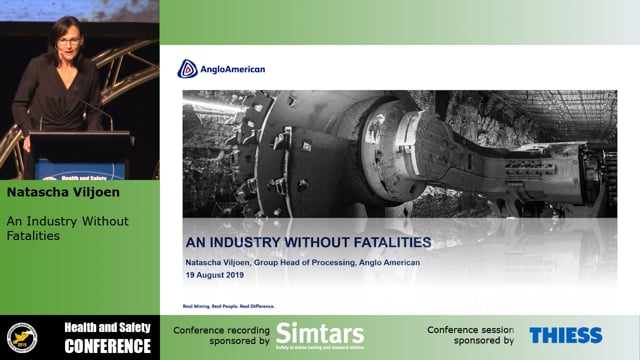
Group Head of Processing, Anglo American
Natascha is responsible for Group Processing, a specialist technical services and support function that ensures safe, responsible and optimized processing performance, through step-change technologies and operational excellence.
With a Metallurgical Engineering degree from North-West University and an Executive MBA from the University of Cape Town (Cum Laude), Natascha also serves on advisory boards at the Universities of Cape Town, Stellenbosch, Pretoria and Queensland University’s Julius Kruttschnitt Mineral Research Centre, having previously held a non-executive position on Anglo American’s Kumba Iron Ore Board.
Natascha has previously worked with ISCOR, Anglo Gold, Anglo Platinum, Samancor Chrome, BHP Billiton and Lonmin.
Ramsay Wells
Business Manager, Queensland Mines Rescue Service
Matthew Farrelly
Manager VRT, Queensland Mines Rescue Service
We live in a world that is constantly changing, and that change continues to accelerate.
Technology has improved the way we train, everything from video animations to learn from disasters, through to e-learning to enhance assessment capabilities.
A new era of training is here, a growing number of organisations are recognising the power of simulation based training. Simulation based training is hardly new, it’s been used in military and aviation for over 50 years – however it has always been expensive and out of reach for most organisations.
Enter the wave of VR and AR headsets available to the consumer, meaning that this technology is now affordable for any business. eg. Walmart uses VR to train over 1 million associates, seeing an improvement in their test scores by 10-15%. This has been achieved by providing almost 20,000 VR headsets across their stores.
QMRS started delivering simulation based training 24 months ago, using desktop-based VR. Then 12 months ago presented headset based training to the industry. Now, the service is preparing to roll out free-roam based VR training for the industry at their Rescue Stations.
24 months is all it has taken to see such a massive change to the way people can be trained.
This presentation will show the journey that Mines Rescue have taken to equip the industry with access to the next generation of cost effective training, that is available right now for the industry’s workforce.
We will highlight the benefits of improved safety outcomes, better prepared employees, safer work environments and value dollar propositions in your continued push to stay meaningful in this technology revolution.
Melton White
Mideco
Mideco provide dust control products and solutions for mines, quarries and any commercial environment. We are an Australian owned company and have been operating since 1950. With over sixty years of successful dust collection experience behind us, Mideco has designed Bat Booth, the system for cleaning workers’ clothes after the shifts, helping prevent dust related conditions like silicosis and black lung.
Approved and recommended by NIOSH, UL certified and installed on sites all over the world, Bat Booth provides the highest value for OHS in mining and quarrying.

Stephen Williams
Engineering Manager, Connec High Voltage Coupler Systems
High voltage (HV) electricity is one of the primary sources of energy within underground coal mines, the effective control of which is fundamental to maintaining a safe working environment. Furthermore, the equipment typically used in HV transmission and distribution is heavy, requiring manual handling to facilitate installation in what can be deemed a confined and harsh working environment.
HV cable coupler and connection systems are an integral and necessary part of mining electrical systems. Underground mining especially has a frequent need to connect and disconnect cables as a result of both the mining process and cable/connector inspection, maintenance and testing regimes. However, current coupler designs which have been in use for several decades consist primarily of a heavy metallic body that inherently limits methods for “testing for dead” prior to touching the coupler.
This presentation describes at a relatively high level the various associated safety benefits that have been incorporated into developing these polymer coupler systems, including the ability to reliably “test for dead” prior to disconnecting a coupler and the substantial weight reductions that allow for improved manual-handling.
Having been supported by ACARP from the outset, Connec has developed the world’s first polymer-based Restrained (≤3.3 kV) and Bolted (≤11 kV) HV coupler systems that are both ANZEx and IECEx certified for use in underground coal mining environments.
Simon Worland
Caltex
Dr Dave Collins and James Forsyth
Synergetics Consulting Engineers
Use of compressed air to clean electrical equipment is a routine maintenance task in heavy mining equipment (HME) across the Queensland Mining Industry. During cleaning elevated levels of harmful dust can engulf the compressed air cleaning operator for extended periods and increase the risk of developing lung diseases including pneumoconiosis and silicosis.
In 2017 the Queensland Mines Inspectorate (Department of Natural Resources, Mines and Energy, 2018) reported that approximately 50% of all respirable dust and Respirable Crystalline Silica (RCS) exceedances in surface coal mines were directly related to the use of compressed air for compressed air cleaning of equipment prior to maintenance.
Respiratory protection has historically been viewed as the primary control to protect the health of compressed air cleaning operators, as higher order controls such as engineering controls have not been considered feasible.
The principal of applying engineering controls for compressed air cleaning of haul truck electrical cabinets was reported and demonstrated at the Queensland Mining Industry Health and Safety Conference in 2018 (Worland, Stream, Brett and Collins). Here the electrical cabinets were converted into full enclosures under negative pressure resulting in a physical barrier between the worker and the dust generating compressed air cleaning task.
This paper describes the further development and field testing of engineering controls over the intervening 12 months. Safe compressed air cleaning has now been demonstrated for a broad range of HME including trucks, excavators, dragline MG sets and stationary equipment. The controls incorporate continuous monitoring of airborne particulate with feedback systems to shutdown compressed air and demonstrate that safe compressed air cleaning is achievable.