Dr. Jenny Legge
Managing Director, JobFit Systems International
Exoskeletons, or wearable robotics, are appearing in scientific journals, industry publications, the media, and even in some workplaces as a potential ‘solution’ for workplace musculoskeletal injury prevention.
This presentation will outline the different types of exoskeletons currently available and their intended uses, including how they can potentially reduce the load on specific muscle groups to minimise fatigue and subsequent injury. However, there are also several documented risks associated with their use in industry. A review of the current evidence base will be presented.
Acceptance of exoskeletons across industries and different work types has been variable and is still in relatively early stages of development and implementation. Mining is often seen at the forefront of safety innovation and can be early adopters of new technologies and processes. Could ‘Exos’ be the next big thing for our industry?
To assist potential users and purchasers to make informed decisions before trial or purchase of such devices, a checklist for independent evaluation will be presented. This takeaway resource will also outline a number of ‘toolspecific’ risk factors to be considered in any onsite formal pre-use / pre-purchase risk assessment for the mining environment.
Josh Leppard
Overburden Supervisor, BMA Saraji Mine
Tragically Saraji Mine had a fatality on New Year’s Eve 2018 involving a bulldozer rolling down an embankment. The first responders to this incident required the use of heavy duty slings and shackles to upright the dozer. This involved personnel traversing down a steep embankment on undulated ground during the night carrying D-shackles that weighed approximately 62kg each, this created a significant manual handling risks to the people involved.
Post incident, Saraji became aware of light weight synthetic couplings that are made specifically for the marine industry that significantly reduced the weight whilst providing exceptional strength properties.
We reached out to the manufacture of the light weight synthetic couplings in New Zealand in an attempt to replicate this technology within the mining industry. By substituting the existing steel D-shackle with a custom made light weight synthetic design, we have reduced the potential of a manual handling incident when recovering surface mobile equipment or the potential for stored energy within the steel to become airborne should the steel D-shackle capacity be exceeded.
The soft couplings were tested to 175,000 kg for a maximum breaking force (MBF) of 510,000 kg without breakage and have a total weight of 8.2 kg compared to the 62 kg steel D-shackles that are normally used.
The synthetic couplings have been successfully trialled on site to extract various pieces of surface mobile equipment. They have been included as mandatory items in the emergency equipment recovery trailer along with other items to aid in the immediate recovery should the need arise.
Dr. Andrew Lingwood
Director and Consultant Occupational and Environmental Physician, OccPhyz Consulting
Fatigue is a vital health and safety issue in the mining industry with a multitude of medical and organisational causes and implications.
This presentation will focus on the nature of circadian rhythms and how they can contribute to fatigue. The ways in which shift work can impact these matters is specifically considered, given the relevance of varied work and shift patterns to the mining industry.
The physiological effects of fatigue will also be discussed, including how these can translate into performance-based effects.
The presentation will also consider the complex interactions between the multiple medical, social and employment factors which contribute to fatigue.
Dr. Nick Mabbott
The Science of Sleep Director, Beyond Midnight Consulting
A raft of work has been done regarding the reduction of fatigue risk. However, a portion of fatigue risk is brought into the workplace by employees who don’t fully understand sleep and its nuances. Good sleep is the cornerstone of fatigue management as it allows employees to reduce fatigue risk prior to arriving for work. Fundamental to this is to have the workforce educated on all aspects of sleep. This includes: What healthy sleep is, how to target the correct amount, how to pay back sleep debts, addressing sleep disorders, developing a healthy attitude toward sleep, understanding health and wellness implications of sleep, and implementing controls when fatigued.
This presentation provides the understanding of the processes that occur within the brain when we sleep. It follows with discussion around different stages and cycles of sleep and how each of these stages add to, or take away from, our safety, health, wellness and productivity. Using the above information, the author has seen first-hand, the differences in people after applying better sleep management practices. There have been improvements in physical and mental health, productivity and safety. Healthy sleep provides a great opportunity to be the “best version of yourself”.
Larnie Mackay
Operations Scheduler, Anglo American-Moranbah North Mine
Anglo American has introduced Australia’s first certified, electronic tablet device for use in underground coal mines. The device provides real-time access to CITECT data for Hazard Awareness and system monitoring, as well as Anglo American’s latest Safety and Health Management processes and documentation.
Developed in collaboration with a tablet manufacturer, the device was developed and tested to achieve International Group 1 Certification together with Queensland Government’s SIMTARS safety in mines certification.
The underground tablet can be used as a portable video communication device (via Skype) to instantly access expert technical advice. Not only does this accelerate operational fault-finding, it also allows a live video link to paramedics in the case of an emergency.
The tablet allows real-time environmental monitoring; provides up-to-date equipment resetting requirements; displays risk-categorised Strata Defect locations pictorially on the Mine Plan; and allows short interval control on the actual plan.
The introduction of the tablet is a major step towards the removal of all underground paperwork and the electronic lodgement of statutory and production reports.
Greg Manthey
Inspector of Mines – Occupational Hygiene, Department of Natural Resources, Mines and Energy
Effectively controlling worker exposure to respirable crystalline silica (RCS) in mineral mines and quarries (MMQ) is an ongoing challenge. Increasing cases of mine dust lung disease show this has not yet been met.
RCS can cause silicosis, lung cancer, chronic bronchitis and emphysema after prolonged exposure. Acute silicosis can result after very high, short term exposure as tragically seen in the manufactured stone industry.
The MMQ sector has nearly 1400 operational sites employing approximately 12,800 workers, many of them at elevated risk from RCS exposures.
The 2017 introduction of the Guideline for the Management of Respirable Crystalline Silica in Mineral Mines and Quarries (QGL02) provided the industry with structures to address RCS exposure. Barriers to effective implementation include:
DNRME’s compliance monitoring program continues the Inspectorate’s close engagement with the sector, ensuring SSE’s understand QGL02 and comply with their obligations including risk evaluation, exposure monitoring and reporting.
This presentation describes findings from the program and focus areas, including:
Darren Marinoff
Principal Consultant – Occupational Hygiene, Greencap
The high-risk nature of the Mining and Resources industry prescribes multiple layers of safety requirements that workers need to undertake to access a site and carry out specific works safely.
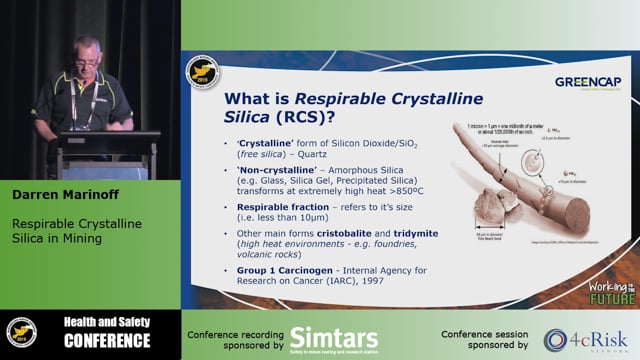
Greencap’s depth of experience in occupational health and safety within the Mining and Resources Industry includes the organisation’s engagement by the South Australian Mining and Quarrying Health and Safety Committee to undertake Respirable Crystalline Silica (RCS) monitoring at various mines and quarries throughout South Australia as part of their Health Surveillance Program. This project alone saw over 1,000 personal and static monitoring samples collected throughout 2016 to 2018.
This presentation will first give background information on the hazards of RCS dust and the risks of exposure. Analysis of the data collected from the monitoring programs will be presented with a focus on elevated exposures relating to Similar Exposure Groups, operational locations and mined/quarried products. Discussion will be presented on observations of existing controls and their effectiveness together with use of respiratory protective devices and a fit testing program conducted during the third year of the program.
Dr Rhiannon McBean,
Research Coordinator, The Wesley Dust Disease Research Centre
Coal Mine Dust Lung Disease (CMDLD) is a term for of all lung diseases caused by inhalation of coal mine dust. CMDLD includes pneumoconiosis; coal workers’ and mixed dust pneumoconiosis (CWP; MDP) and silicosis, as well as inflammatory-type diseases such as chronic obstructive pulmonary disease (COPD). CMDLD was undetected in the Queensland coal industry from 1984 to 2015. We aimed to understand the spectrum and severity of disease in recently diagnosed CMDLD cases (n= 79) by reviewing medical imaging, charts, lung function and occupational history.
CMDLD pneumoconioses were diagnosed in 71% of cases; CWP was most common (34%). Advanced disease was observed on medical imaging for 24% of subjects. Lung function results were equally split, 47.2% normal and 52.7% abnormal. On average, the tenure in coal mining was 26 years (range 6-45). The majority of subjects (44%) had only worked in underground coal mines. Surprisingly, 27% of subjects reported to have never worked in an underground coal mine.
We observed a diverse spectrum of diagnoses and severity ranged from mild to severe. Occupational history in terms of tenure and mine type varied across the subject group. It is hoped these findings will boost awareness of CMDLD
The aim of the Workshop is to provide an interactive forum where approaches to fatigue management may be discussed with experts and peers, with participants having the opportunity to take part in a fatigue risk assessment exercise.
The Workshop will be led by:
Prof. Naomi Rogers
Specialist Fatigue Consultant, Naomi Rogers Fatigue Consulting
John Tate
Barrister, Crown Law
Katie Harrold
Health, Safety and Emergency Management Advisor, Dalrymple Bay Coal Terminal Pty Ltd
Industry Representatives from the Mine Inspectorate, Management and Workforce