



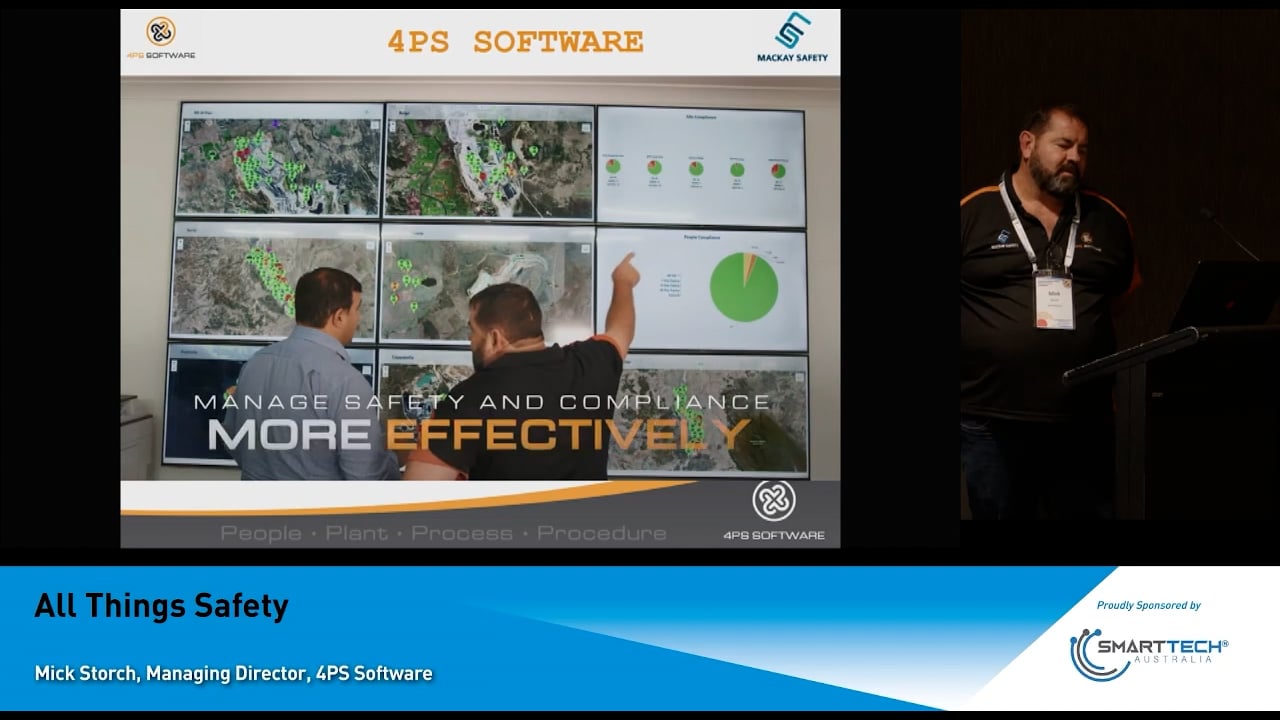
Mick Storch
Managing Director, 4PS Software
4PS software is an innovative Australian owned and operated company since 2009.
Streamlining business processes and compliance management of People, Plant, Processes and Procedures in your workplace. Access employees training and competencies with a click of a button, automated notifications to alert you before competencies and inspections expire, generated equipment registers and employee matrixes, project management tools, and so much more. Ensuring your people and plant get on to the work site on time, every time. Check it out here:www.4ps.com.au

Michael Stubley – Principal Consultant – Rapid Response
Geri Morrell – Client Manager – Resources Sector and Regional Queensland, Converge International
ABSTRACT
Evidence-based reviews have concluded that ‘debriefing’, also known as The Mitchell Model has little effect, or that it actually worsens the trauma symptoms. Yet, many sites, often unknowingly, are still using this model.
This presentation will discuss what Psychological First Aid is (and isn’t), and how Leaders can effectively apply it to ensure that their people are supported in the immediate aftermath of a Critical Incident.

Nick Sutherland
MyndFit
Cristian Sylvestre, Managing Director, HabitSafe

Cristian Sylvestre – Managing Director, HabitSafe
ABSTRACT
Most organisations think of personal safety in terms of hazards, knowledge or conscious decisions. Although these have merit, and may be part of an overall solution, they are not enough to prevent all incidents in mining. So, what is missing?
Neuroscience estimates that 95% of what we do is subconscious. That is, the majority of our actions are mostly done while on autopilot, and not just low risk ones. We are aware of what we are doing, but we are not making “active” conscious decisions from step to step. This is not because of psychology; it is because of the brain chemistry in humans that resulted from evolution.
Although being in autopilot serves us well most of the time, it can also result in unintentional incidents. The solution is not to do away with autopilot (as if we could), but to use behaviour-change science to help people be safer.
Drawing on the latest research, this presentation explores the role played by inattention and distraction while being on autopilot. If people can understand (without blame or fault) how unintentional incidents come about, and how these can be minimised, they engage more fully, comply more and make “safer” conscious decisions. This enables people to contribute with more purpose to a positive safety culture, thereby improving safety performance significantly.
Safety performance data collected from 7 Australian coal mine operations (open cut and underground) show an average of 60% reduction in TRIFR within 2 years.
Cristian Sylvestre, Managing Director, HabitSafe
Cristian Sylvestre
Managing Director, HabitSafe
There has been considerable research (empirical studies and academic papers) during the last 10 years investigating human decision making.
The most disruptive discovery is that what we think of as a deliberate choice (an “active” conscious decision) happens fundamentally in the subconscious and is fed to the conscious mind very late in the neurological process. This is why it feels like we only make conscious decisions.
Three thinking principles help explain human decision making and enable us to understand human behaviour better.
These are automatic thinking (autopilot), social thinking and mental thinking models. As such, they also provide valuable clues to determine how we can future-proof efforts by organisations to make behaviours safer.
The lessons from these three thinking principles can be applied to three different layers in organisations:
- Leadership
- Teams
- Individuals
The latest findings from studies in neuroscience, behaviour science, cognitive behavioural science and neuropsychology are used to explain how safety behaviour can be influenced more effectively.